
Hospital Website Development
For Geriatric Health Services Facilities
Website Development Campaign
Apply for a geriatric health services facility website through the campaign page and receive the normally optional fee calculator for residential and day-care services free of charge.
Considering a Hospital Website Redesign?
Do Any of These Challenges Sound Familiar?
- You want to redesign your hospital website but are struggling to choose a supplier.
- Your redesign budget is limited.
- You do not know where to start.
- You are unsure what content to publish.
- Your supplier is slow to respond to update requests.
- Monthly maintenance and page update fees are high.
- You do not know how to improve the website after launch.
The Information System Department has specialised in hospital and healthcare websites to meet the diverse needs of Tokushukai Group hospitals nationwide.
Reviewing many hospital websites has revealed some common issues.
Healthcare appears to lag behind other industries in Internet-based marketing and communications, including websites. Hospitals often do not communicate their initiatives effectively online, which we feel is a missed opportunity.
If you are considering a hospital website redesign, we hope the following information will be useful.
A Redesign Needs Better Content as Well as a New Appearance
When redesigning a hospital website, consider the following:
- The purpose of the redesign
- The need to renew content as well as the visual design
- The problems with the current website, including feedback from patients and staff
- Requests from people inside and outside the hospital
- Proposals for addressing these issues
Common reasons we hear for redesigning a website include:
- Updating an outdated design
- Supporting smartphones through responsive layouts
- Strengthening recruitment, particularly for doctors, nurses, pharmacists and rehabilitation professionals
- Reducing high maintenance fees
- Relocation to a new hospital building
These are valid reasons. Updating the design and supporting smartphones are particularly important in today's mobile-centred communications environment.
Recruitment information is also important, as hospitals face shortages of doctors, nurses and allied health professionals.
However, a hospital website redesign is usually a major project undertaken only once every few years. Costs can range from hundreds of thousands to several million yen, depending on the number of pages and the developer.
To make a redesign successful, we believe the website's role and objectives must be clear.
Most hospital websites primarily serve the local community, so attracting visitors is particularly important. Changing the appearance alone is insufficient; the content must also improve.
Even within one hospital website, the amount of content can vary significantly between clinical departments. Simply including or omitting a doctor's photograph may affect whether someone decides to seek care.
An explanation of a condition and its treatment may also lead to an outpatient visit. Providing useful information is essential.
Obtaining copy from doctors who are busy with daily clinical work can be difficult. Younger doctors often recognise the importance of the website, and we are seeing more actively contribute content.
To make writing easier, we provide draft outlines for almost every page, not only clinical departments. Hospitals can adapt them to their circumstances, which tends to make collecting content easier.
Consider Running Costs after Launch
A redesign budget should include ongoing monthly costs as well as development costs. Running costs vary by supplier and by the amount of updating requested. Costs tend to be lower when the hospital handles updates itself.
We introduce our Hospital CMS, which allows anyone to update content. We recommend letting hospitals manage straightforward updates themselves to avoid unnecessary expense. See the Hospital CMS section for details.
We provide support to reduce the burden on hospitals as much as possible.
Our Approach to Hospital Websites
Experience with More Than 40 Hospital Websites
We bring extensive expertise in hospital website development.
Over approximately nine years, we have developed websites for around 40 hospitals. Hospital websites differ from ordinary corporate and service websites, including in the behaviour of their visitors.
Providing information to patients who visit the hospital is important. Offering useful healthcare information to people who do not currently visit also adds value. We believe this makes a website more accessible, attracts new users and helps create a hospital that is open to a wider community.
A website's launch or redesign is only the beginning. Hospital websites grow through daily analysis and repeated improvement. We support this growth through the Plan–Do–Check–Act (PDCA) cycle.
Here is an example of the PDCA cycle.
-
Plan
-
An important purpose of a hospital website is to help increase outpatient visits, although directly measuring this effect can be difficult. Website visits can be counted and analysed and are one measure of performance. Reaching more people matters, so we believe it is important to set visit targets and work towards them.
For recruitment, one measure is the number of people hired through the website. Where recruitment is a major priority, we propose a separate recruitment website because its purpose differs from that of the hospital website.
-
Do
- Once the plan is agreed, implementation begins. The website launches when development proceeds as planned—but this is the starting point. Visitor numbers often rise rapidly just after a redesign, partly due to publicity.
However, it may take time for the site to appear in search engines such as Google. -
Check
- Evaluate whether the actions achieved the planned targets. If the target was 100,000 visits, check whether that number was reached. If the recruitment target was 100 applications, check the application count.
-
Act
- If targets have not been reached, identify the problems and decide how to improve. For visitor targets, options include attracting more visits, improving the interface and content, reducing bounce rates, encouraging movement to other pages, improving load speed, checking keyword placement and addressing on-page SEO.
Repeating this cycle and working towards the goals every day is important. We prepare monthly visitor analysis reports so hospitals can understand the results of ongoing website operation.
These reports go beyond automatically delivered totals. Analysing visitor numbers, frequently viewed pages and exit pages reveals patterns in how the website is used.
Examples include:
- Where visitors go after arriving on the home page
- What information outpatients need and which pages they view most
- What makes a clinical department page informative
- Which pages most often serve as landing pages
- Which pages have high bounce rates and where visitors leave
- Whether visits are increasing and loading speed and bounce rates are improving
- Whether content is becoming more comprehensive
In addition to providing reports, we sometimes attend hospital meetings to present the findings. Please use this support in your hospital's marketing activities.
Development Features
The following explains how we approach hospital website development.
Content Proposals
Before development, we organise the required information through discussions with hospital staff. Taking the hospital's priorities into account, we use our experience to propose suitable content.
Some content is especially important on hospital websites and must be prioritised.
Page Layout
Once the content is agreed, we propose a home page layout and refine it towards the hospital's vision. Hospital websites must accommodate visitors of all ages.
Home Page Design
Using the content and layout, we create design proposals reflecting the hospital's characteristics, vision, image and colours. The home page attracts the most visitors to an individual page and serves as the hospital's public face, so we give it particular attention.
We refine the design together with hospital staff. A single proposal can make it difficult to elicit ideas, so we always prepare two or three options and improve them through comparison.
Design is more than appearance. Some websites focus so heavily on looks that important information is lost. Judging a hospital website only by visual appeal is risky. Visitors span all ages, and younger smartphone users may view different pages from desktop users.
Even an attractive website will lose visitors and fail to achieve its goals if it is difficult to use. Usability and structure are essential parts of design.
A premium impression may sometimes be appropriate, but trust, cleanliness and reassurance are particularly important for hospital websites. The information intended for users must also be conveyed clearly and accurately.
We consider the following especially important:
- Conveying information accurately and clearly
- Providing patients with timely information
- Continuing to publish new hospital information
- Communicating the hospital's strengths, specialties and vision
We design with these requirements in mind.
Inner Page Design
Although the home page is usually the most visited individual page, it accounts for around 20% of all page views on hospital websites with tens or hundreds of pages, depending on the total page count.
Inner pages account for approximately 80%.
More than 70% of visitors arrive through search engines such as Google or Yahoo. Search terms differ between users, and visibility depends on those terms.
The hospital name is the most common search term, but not everyone arrives that way. People using other terms are more likely to be new users. Inner pages that serve as landing pages are therefore particularly important. Their content, layout and design must help visitors find the information they need without frustration.
We propose inner page designs based on experience of which pages serve as landing pages, which have high bounce rates, and whether visitors received satisfying information even when they left after one page.
System Development
Websites include more than static pages: contact forms, recruitment applications and health screening appointments are examples. Hospitals also have many frequently updated pages. We provide systems that let hospital staff update these themselves, which can be faster than asking a supplier.
Integration with Other Systems: Appointments and Health Screening
Requests for consultation and health screening appointments from smartphones are increasing. Adding booking functions to the hospital website allows integration with other systems.
Online booking can help increase appointments, encourage younger patients to visit and reduce the time staff spend answering telephone calls.
Hospital websites serve not only patients but also staff, local healthcare providers, suppliers and recruitment-related users.
We receive many requests to systematise interactions with these users and expect such projects to increase.
Smartphone and Tablet Support
Smartphones now account for more than 60% of visits. Since Google's 2016 announcement of mobile-first indexing, we have adopted responsive hospital websites. We also support tablet sizes for the smaller proportion of users—under approximately 10%—who use them.
Hospital CMS
No Specialist Technical Skills Are Needed to Maintain Your Hospital Website.
Our independently developed Hospital CMS makes this possible.
CMS (Content Management System):
A system that allows people to update a website easily without website editing skills. Blogs are one example.
We believe hospitals should be able to update frequently changing pages without asking a supplier. This requires a system for managing those pages.
News and Announcements
The frequency of news updates shows how active a hospital website is. Frequent updates can improve its standing with visitors and search engines.
Typical announcements include:
- Updated outpatient schedules
- Consultation cancellations and substitute doctors
- Recruitment notices
- Health lecture announcements
- New hospital newsletter issues
- Updates to clinical department and doctor information
When hospitals update announcements themselves, they can continue publishing current information.
Outpatient Schedules and Doctor Rosters
Outpatient schedules may also identify the doctors responsible for each clinic. These pages change weekly or monthly and are particularly important to patients planning a visit. Unexpected changes also make frequent updates necessary.
Clinic Cancellations and Substitute Doctors
A clinic may be cancelled at short notice, so this information must be updated promptly. Some hospitals include it in their outpatient schedules.
Clinical Department Information
Doctors change as staff join or leave. Many patients choose a doctor before visiting, making this information important. Including photographs as well as names can make a difference; we recommend photographs.
Staff changes can also mean that a listed specialty is temporarily unavailable or that a new department opens. Clinical department information is therefore both important and frequently updated.
Departments and Centres
Hospitals bring together specialists who work as teams to provide medical and social care. Websites often have separate pages for these professional departments.
Each profession has its own content and priorities. Some pages address students as well as patients. We are extending Hospital CMS use to these departments and centres.
Health Lectures
Many hospitals hold health lectures for local residents and patients as part of community communications. Frequency varies, but early publicity is important to attract participants. Depending on the schedule, these pages benefit from being updated by the hospital.
Hospital Newsletters
Like health lectures, regular newsletters support hospital communications. They convey openness and build familiarity and trust, while creating opportunities for people to engage with the hospital.
Many hospital websites offer newsletters as downloadable PDFs or other electronic files. An advantage of the website is that past issues remain available as an archive.
Recruitment Information
Recruitment is a common reason for redesigning a website, and separate recruitment sites have become more common in recent years. Where recruitment remains part of the main website, hospitals need to switch advertised roles on or off and update job details themselves. Leaving closed vacancies online or publishing open positions late can prevent timely recruitment.
Suppliers can update these pages, but outpatient schedules may require frequent changes affecting only a small amount of content. Cancellation notices in particular need immediate updates. Delays can lead to patient complaints.
Hospital staff can sometimes update frequently changing pages more quickly. We therefore actively develop systems to make these updates simple. Supplier charges can also become substantial, so care is needed.
We believe the best approach is to pay for work that requires it, such as creating new pages, while letting hospitals handle simple updates. We help make website operations more efficient and communication with users smoother.
Development Costs
Custom Development
We build flexible, bespoke hospital websites. We visit the hospital to discuss the reasons for redesigning, existing problems and requirements. Based on these discussions, we provide content proposals, two or three design options, copy coordination and photography as an integrated service.
Hospital CMS is included as standard. CMS functions can also be added to hospital-specific pages, and the website can integrate with consultation and health screening appointment systems.
Template Package
Drawing on our experience, we developed a template package with a clear, standard design. This all-in-one package provides the content users need and lets hospitals update it themselves. For a high-quality hospital website on a limited budget, we consider it our best-value option.
Package Comparison
| No | Feature | Custom | Template |
|---|---|---|---|
| 1 | Design flexibility for home and inner pages | ◎ | △※1 |
| 2 | Content proposals | ◎ | ◎ |
| 3 | Smartphone support | ◎ | ◎ |
| 4 | Tablet support | ◎ | ◎ |
| 5 | Hospital CMS: news, outpatient schedules, clinical departments and more | ◎ | ◎ |
| 6 | Contact form | ◎ | ◎ |
| 7 | Recruitment application form | ◎ | ◎ |
| 8 | Health screening and comprehensive check-up booking form | ◎ | ◎ |
| 9 | Visitor analysis | ◎ | ◎ |
| 10 | On-page SEO functions | ◎ | ◎ |
| 11 | Server setup, maintenance and management | ◎ | ◎ |
| 12 | Backup measures | ◎ | ◎ |
| 13 | SSL encrypted communication | ◎ | ◎ |
| 14 | Photography | ◎ | △※2 |
*1: A design fee of JPY 40,000, excluding tax, applies.
*2: Photography costs JPY 40,000, excluding tax, plus travel expenses.
Development and Maintenance Fees
Please contact us about both custom development and template package pricing. We prepare a quotation after discussing your requirements.
Maintenance and update fees are discussed according to the contract and other requirements.
Implementation Process
-
Contact the Information System Department by phone or through the contact form.
-
Arrange a meeting to discuss your requirements.
-
We provide a proposal and quotation based on the initial consultation.
-
Proceed to the next step after placing an order.
-
We submit a content plan and two or three home page designs.
-
Refine and finalise the home page design.
-
Request content from the hospital, using the draft outlines we provide.
-
Develop the inner pages.
-
Complete all pages and check their operation.
-
Launch after the hospital's approval.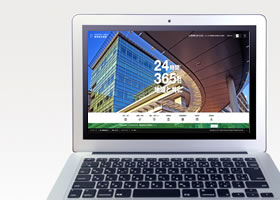
Meet the Team
Yuma Nakamura, web business team
| Team | Web business team |
|---|---|
| Home Prefecture | Osaka |
Case Study
Haibara General Hospital(Makinohara, Shizuoka)
Websites developed: hospital and nursing department websites
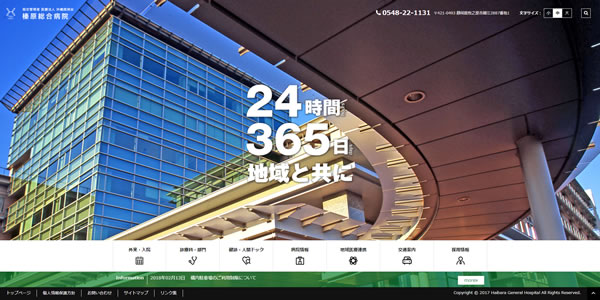 Haibara General Hospital Website
Simple and Easy to Understand
A Hospital Website with a Bounce Rate below 30%
Haibara General Hospital is located in Makinohara, Shizuoka. We were approached about redesigning its website around August 2017.
Initial Consultation
The hospital had operated its website for many years. We discussed its reasons for redesigning, and a range of problems emerged.
- Identified Problems
-
- Information was difficult to find and navigation was unclear.
- Staff photographs were too small to give a sense of the people working there.
- Clinical department and other departmental pages lacked content.
- Recruitment pages were limited despite the emphasis on recruiting nurses and other staff.
- The website did not cover initiatives the hospital was actively pursuing.
- Smartphones and tablets were not supported.
Operational issues also included outdated information and slow updates.
Recruitment Support
We decided to create a separate nursing recruitment website. The main hospital website serves patients, so a dedicated site can be more effective than prominently advertising doctor and nurse vacancies on its home page.
Nursing recruitment often focuses on new graduates, attracting younger visitors. A site aimed at nurses and young women can use a design suited to that audience, which may be difficult within the main hospital site. Comprehensive nursing content may also improve search visibility and lead to applications.
Development Schedule
We prepare a schedule at the start of a hospital website project. Using a basic three-month development period, we check progress daily on design, content collection, inner page production and testing. Delays in either content or development can affect the planned launch.
Home Page Design
We submitted three options, including a basic layout and a design built around a single large photograph. The hospital requested a simple, stylish appearance and selected the large-photograph design.
Preparing Page Content
The hospital coordinator collected content very actively, sending page copy almost every day. We provided draft outlines in advance for staff to use.
Some hospitals request unique content, and we aim to respond flexibly.
Developing Inner Pages
We created approximately 100 pages from the hospital's copy. Our experience of developing websites for 40 hospitals helped us choose clear layouts for each type of page.
Pages using the CMS require a common structure, which we considered during development. We also asked the hospital to review inner pages with particular design requirements.
Checking Page Content
We checked every page against the supplied copy for errors and omissions, paying particular attention to information that affects patients' visits.
Device Testing: Smartphones and Tablets
More than 60% of website visitors use smartphones. Testing on smartphones and tablets is therefore essential.
Launch
After checking all pages, we obtained the hospital's final approval and launched the redesigned site. The old website also needed to be backed up as a precaution.
Results
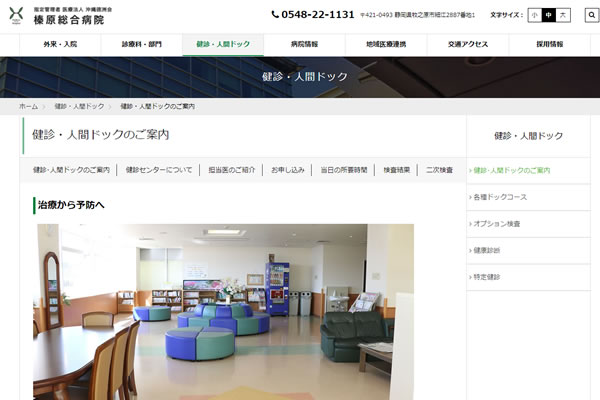
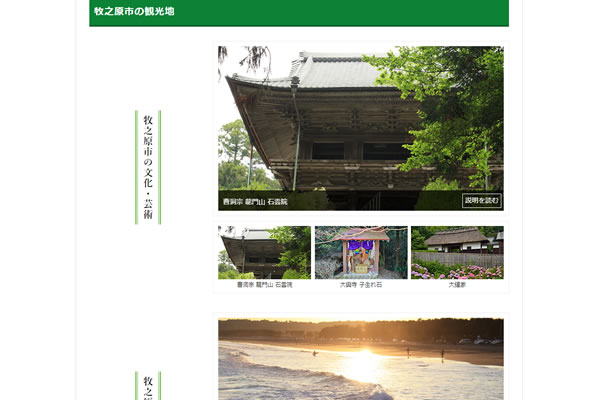
After launch, we analysed visitor numbers and behaviour, comparing the old and new sites to identify improvements and further work.
One result was increased visitor numbers and a bounce rate in the 20% range.
We will continue enriching content and improving on-page SEO to attract more visitors and further improve the website.
Designer Comments
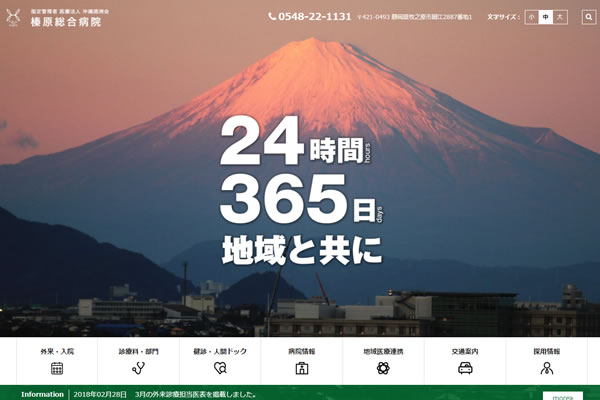
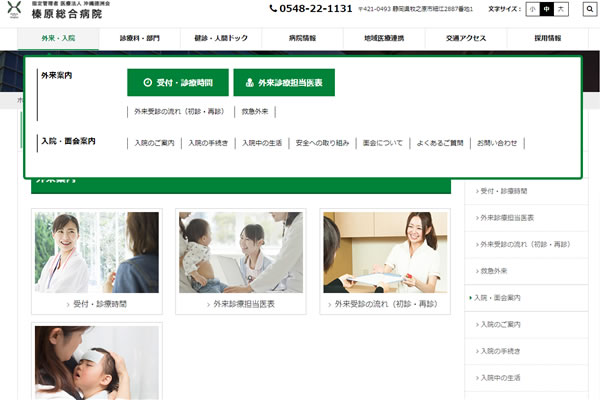
The request was for a stylish appearance rather than an emphasis on softness or warmth, so I used a design with straight lines. The green from the hospital logo is the key colour.
Full-screen photographs of the striking hospital exterior and beautiful Mount Fuji, characteristic of Shizuoka, create visual impact.
A mega-menu in the main navigation helps visitors move between pages.
Our Work
Hokkaido
| Implementation Date | Hospital | Offices |
|---|---|---|
| June 2020 | Kyoaikai Hospital | 7-21 Nakajima-cho, Hakodate, Hokkaido |
| February 2021 | Obihiro Tokushukai Hospital | 14-2-1 Kino-nishidori, Otofuke-cho, Kato-gun, Hokkaido |
| February 2024 | Sapporo Surgical Memorial Hospital | 15-chome Minami 23-jo Nishi, Chuo-ku, Sapporo |
Tohoku
| Implementation Date | Hospital | Offices |
|---|---|---|
| March 2016 | Sendai Tokushukai Hospital | 9-8 Takatama-cho, Izumi-ku, Sendai, Miyagi |
| November 2019 | Shinjo Tokushukai Hospital | 4623 Komaba, Torigoe, Shinjo, Yamagata |
| December 2021 | Shonai Amarume Hospital | 1-1-1 Shoyo, Shonai-machi, Higashitagawa-gun, Yamagata |
Kanto
| Implementation Date | Hospital | Offices |
|---|---|---|
| August 2015 | Narita Tomisato Tokushukai Hospital | 1-1-1 Hiyoshidai, Tomisato, Chiba |
| September 2017 | Hanyu General Hospital | 551 Kamiiwase, Hanyu, Saitama |
| January 2019 | Dainichi Tokushukai Hospital | 933 Dainichi, Yotsukaido, Chiba |
| December 2019 | Minano Hospital | 2031-1 Minano, Minano-machi, Chichibu-gun, Saitama |
| February 2020 | Tokyo Nishi Tokushukai Hospital | 3-1-1 Matsubara-cho, Akishima, Tokyo |
| September 2020 | Shirane Tokushukai Hospital | 2294-2 Nishino, Minami-Alps, Yamanashi |
| March 2021 | Future Medical Research Center | 1-8-7 Kojimachi, Chiyoda-ku, Tokyo |
| May 2021 | Shonan Atsugi Hospital | 118-1 Nurumizu, Atsugi, Kanagawa |
| July 2021 | Musashino Tokushukai Hospital | 3-5-48 Mukodai-cho, Nishitokyo, Tokyo |
| April 2022 | Hayama Heart Center | 1898-1 Shimoyamaguchi, Hayama-machi, Miura-gun, Kanagawa |
| February 2023 | Shonan Oiso Hospital | 21-1 Gakkyo, Oiso-machi, Naka-gun, Kanagawa |
| August 2024 | Akirudai Hospital | 6-5-1 Akigawa, Akiruno, Tokyo |
Tokai
| Implementation Date | Hospital | Offices |
|---|---|---|
| July 2017 | Ogaki Tokushukai Hospital | 6-85-1 Hayashi-machi, Ogaki, Gifu |
| December 2017 | Haibara General Hospital | 2887-1 Hosoe, Makinohara, Shizuoka |
| May 2018 | Shizuoka Tokushukai Hospital | 11-1 Shimokawahara-minami, Suruga-ku, Shizuoka |
Kansai
| Implementation Date | Hospital | Offices |
|---|---|---|
| April 2014 | Nozaki Tokushukai Hospital | 2-10-50 Tanigawa, Daito, Osaka |
| June 2014 | Suita Tokushukai Hospital | 21-1 Senrioka-nishi, Suita, Osaka |
| December 2014 | Izumi City General Hospital | 4-5-1 Wake-cho, Izumi, Osaka |
| May 2015 | Ikoma City Hospital | 1-6-2 Higashi-Ikoma, Ikoma, Nara |
| July 2015 | Kishiwada Tokushukai Hospital | 4-27-1 Kamori-cho, Kishiwada, Osaka |
| February 2017 | Yao Tokushukai General Hospital | 1-17 Wakakusa-cho, Yao, Osaka |
| November 2017 | Matsubara Chuo Hospital | 1-2-32 Ao, Matsubara, Osaka |
| July 2018 | Omi Kusatsu Tokushukai Hospital | 3-34-52 Higashiyagura, Kusatsu, Shiga |
| August 2018 | Higashiosaka Tokushukai Hospital | 3-6-11 Hishie, Higashiosaka, Osaka |
| October 2018 | Kobe Tokushukai Hospital | 1-3-10 Kamitakamaru, Tarumi-ku, Kobe, Hyogo |
| September 2021 | Zennan Hospital | 2-3-18 Kokubu-honmachi, Kashiwara, Osaka |
Chugoku and Shikoku
| Implementation Date | Hospital | Offices |
|---|---|---|
| April 2019 | Uwajima Tokushukai Hospital | 2-6-24 Sumiyoshi-cho, Uwajima, Ehime |
Kyushu
| Implementation Date | Hospital | Offices |
|---|---|---|
| September 2012 | Futsukaichi Tokushukai Hospital | 4-8-25 Futsukaichi-chuo, Chikushino, Fukuoka |
| April 2018 | Nagasaki Kita Tokushukai Hospital | 1-5-1 Hokuyodai, Nagayo-cho, Nishisonogi-gun, Nagasaki |
| October 2018 | Kagoshima Tokushukai Hospital | 3-8-1 Shimoarata, Kagoshima |
| October 2019 | Fukuoka Tokushukai Hospital | 4-5 Sugukita, Kasuga, Fukuoka |
| November 2021 | Osumi Kanoya Hospital | 6081-1 Shinkawa-cho, Kanoya, Kagoshima |
Remote Islands and Okinawa
| Implementation Date | Hospital | Offices |
|---|---|---|
| December 2014 | Okinoerabu Tokushukai Hospital | 2208 Serikaku, China-cho, Oshima-gun, Kagoshima |
| March 2015 | Nanbu Tokushukai Hospital | 171-1 Hoka, Yaese-cho, Shimajiri-gun, Okinawa |
| December 2016 | Naze Tokushukai Hospital | 28-1 Naze-asahi-machi, Amami, Kagoshima |
| December 2019 | Tokunoshima Tokushukai Hospital | 7588 Kametsu, Tokunoshima-cho, Oshima-gun, Kagoshima |
| July 2021 | Yoron Tokushukai Hospital | 403-1 Chabana, Yoron-cho, Oshima-gun, Kagoshima |
As of 2026-10
For Geriatric Health Services Facilities
Website Development Campaign
Apply for a geriatric health services facility website through the campaign page and receive the normally optional fee calculator for residential and day-care services free of charge.
Contact Us
Contact the Tokushukai Information System Department to discuss hospital website development.
Contact Us by Phone
06-6346-2821
Weekdays, 9:00–17:00 (web business team)