
Tokushukai Group and Siemens Healthcare
Joint research on AI for diagnostic imaging
Also pursuing full automation of laboratory testing
On 5 February, the Tokushukai General Incorporated Association Information System Department, which provides headquarters functions for the Group through its Tokyo and Osaka offices, and Siemens Healthcare of Tokyo held a press conference at the association's Tokyo headquarters. They announced a partnership covering joint research on AI-supported diagnostic imaging, full automation of laboratory testing workflows, and an ultrasound training programme to optimise staff capabilities. The aim is to improve both the quality and capacity of care and transform healthcare services. Initial AI research will focus on supporting assessment of chest CT images, with results planned by July. AI-assisted interpretation is also expected to improve care on remote islands and in rural areas.
Optimising staff capabilities to improve the patient experience
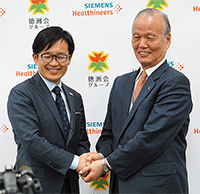 Chairman Suzuki, right, and President Mori shake hands at the press conference
The partnership brings together Tokushukai, which holds extensive medical data and aims to strengthen community care by adopting advanced medical approaches, and Siemens Healthcare, which works worldwide to enhance the value delivered by healthcare providers.
Work will initially centre on Shonan Kamakura General Hospital in Kanagawa, which has 648 licensed beds. It is one of Tokushukai's flagship hospitals and holds Joint Commission International (JCI) accreditation.
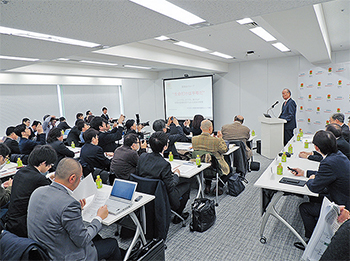 Many media representatives attended the press conference
The hospital is pursuing several projects to become a highly capable provider of next-generation care. These include an advanced medical research centre with proton therapy for comprehensive cancer treatment, and new trauma and emergency care centres. The partnership forms part of this development.
The partnership has three main elements. First, Tokushukai and Siemens will establish an AI Collaboration Center at nearby Shonan Health Innovation Park as a joint research and development base for AI software supporting chest and other imaging. Second, advanced laboratory and specimen transport systems will further automate testing at the hospital. Third, a US (Ultrasound) Academy will provide ongoing Siemens equipment training so the hospital's medical technologists can perform more specialised physiological examinations.
Supporting healthcare on remote islands and in rural areas
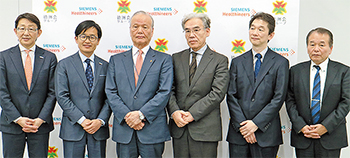 Press conference participants, from left: Siemens Healthcare Managing Executive Officer Akihiko Naito; President Hideaki Mori; Chairman Takao Suzuki; Shinichi Higashiue, Vice Chairman of Tokushukai Medical Corporation; Jin Lee, Head of Radiology at Shonan Kamakura; and TIS President Katsuhiko Ozaki
As imaging technology advances, diagnostic imaging plays an expanding clinical role, while doctors face increasing workloads from interpreting large volumes of images. Greater specialisation also makes it important to understand and share imaging information across disciplines.
The AI Collaboration Center will address these challenges through joint research into software supporting chest CT interpretation. Chest scans are among the most common CT examinations, accounting for approximately 25% according to a 2018 Siemens Healthcare survey.
The AI will support interpretation across the chest, including the lungs, heart, aorta and spine, and flag images that radiologists should examine more closely.
This is expected to improve efficiency and accuracy and help detect unexpected abnormalities earlier. It may also improve services in island and rural communities in the future.
Tokushukai Information System, Inc. (TIS), the association's wholly owned subsidiary in Osaka, will collect the Group's medical data, anonymise it and provide it for research with rigorous confidentiality safeguards.
Potential to reduce laboratory work by 33%
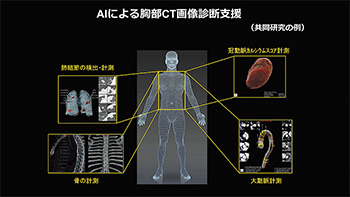
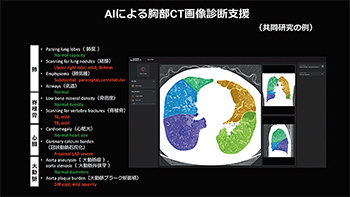 Example of joint AI research
Medical technologists spend considerable time sorting, transporting and disposing of test tubes. A Siemens Healthcare study found that a specimen transport system could automate work accounting for approximately 33% of staff time. The estimate was based on the daily time spent by Shonan Kamakura staff on reception, biochemistry, haematology and related specimen testing tasks that could be automated through a transport line.
The hospital will introduce Siemens Healthcare's Atellica Solution integrated immunoassay and clinical chemistry system and Aptio Automation specimen transport system to improve workflow.
In a first for Japan, the hospital will connect outpatient blood collection tables and the ward pneumatic tube system to specimen automation. This will advance full automation of testing and allow technologists to focus on their specialist work. Operation is planned for October.
Also planned for October, the US Academy will offer Siemens ultrasound equipment training and current information so technologists can perform physiological examinations and make fuller use of their skills.
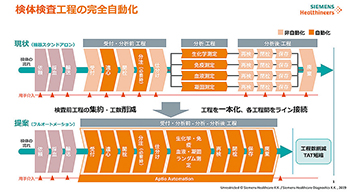 Workflow for fully automated specimen testing
Ultrasound is one of the most widely used examinations in clinical practice. Equipment requires relatively little space, images can be interpreted in real time, and the examination causes patients no pain or side effects.
Through the US Academy, the hospital aims to expand its high-demand, non-invasive ultrasound service and provide care more closely attuned to patients. It is also considering on-demand ultrasound examinations in the future.
Supporting work-style reform, with expansion to other Group hospitals
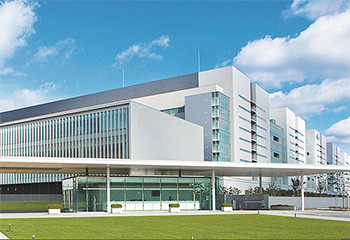 Shonan Health Innovation Park, the base for joint research and development
Work-style reform is an urgent issue in healthcare. Using AI to improve imaging efficiency, improving laboratory workflows and training technologists to make the best use of their capabilities all support this effort. Running projects in these three areas simultaneously is also unprecedented internationally.
Results from the joint research will be introduced first at Shonan Kamakura and then at other Tokushukai hospitals to improve safety, quality and the patient experience across the Group.
Association Chairman Takao Suzuki said: “This partnership will improve clinical workflows, enable higher-quality services and accelerate improvements in the patient experience. It could mark the dawn of a new era in healthcare.” Siemens Healthcare President Hideaki Mori added: “We are confident this will help improve the quality and efficiency of care within Tokushukai and, ultimately, throughout Japan.”
Source: Tokushukai Newspaper, 11 February 2019, No. 1171